
01
Restore the Human
The Renaissance begins by refusing to reduce the human being to worker, consumer, demographic, resource or function.
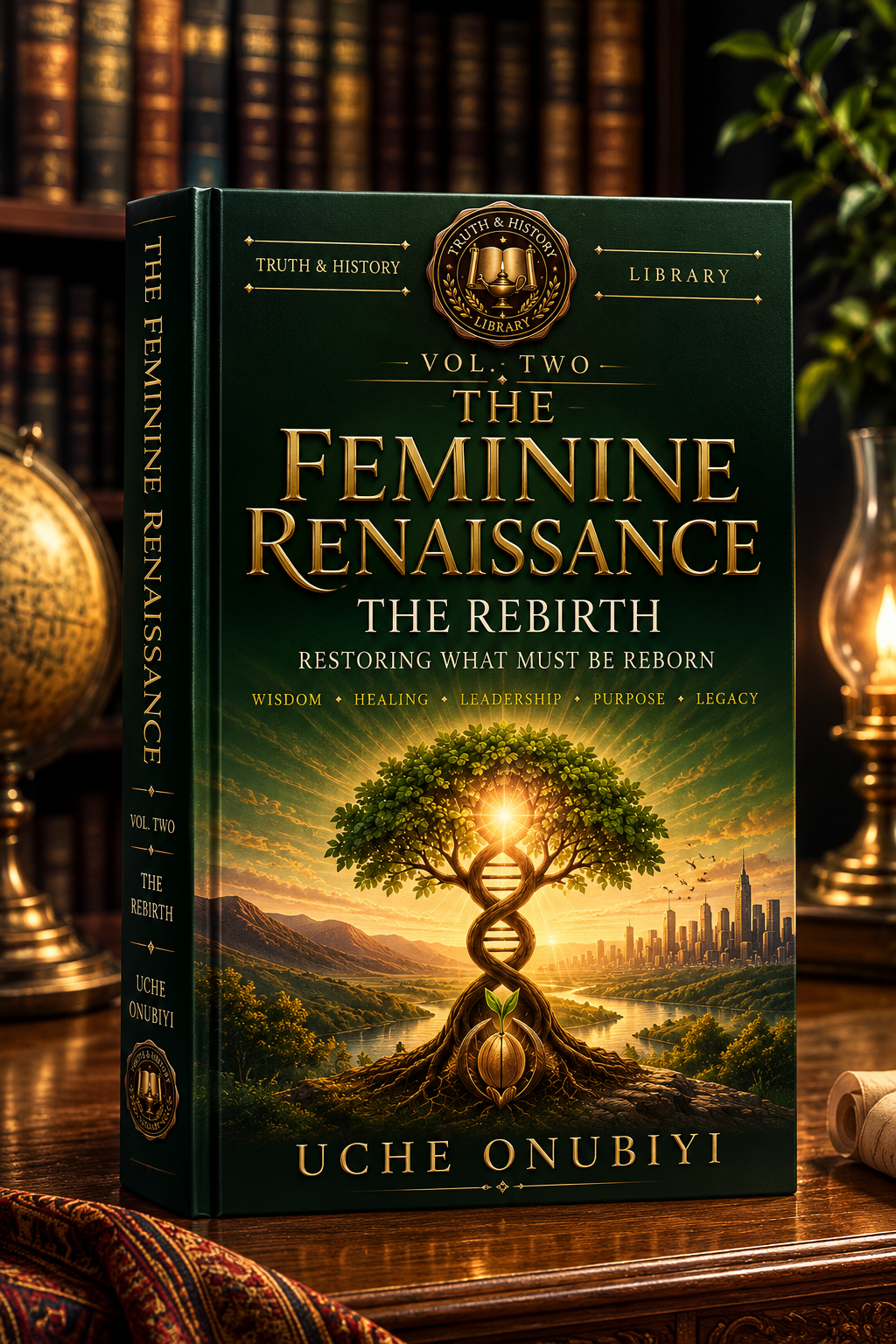
The Feminine Renaissance · Volume Two
Restoring What Must Be Reborn
If Volume One remembers the dimensions of humanity that became obscured, Volume Two asks how those capacities can return—not as nostalgia, but as living principles capable of taking form in the present.
Uche Onubiyi
Share This
About Volume Two
Remembering is necessary, but memory alone does not transform a civilization. Once something valuable has been recognized, the harder work begins: determining how it can live again.
The Rebirth examines restoration without demanding a return to an earlier society. Ancient forms belonged to their environments, technologies, challenges and historical moments. The task of a renaissance is different.
We must distinguish the enduring principle from the historical form that once carried it.
The question becomes: how can reception, nurture, protection, relationship, carrying, regeneration, wisdom and maturation take new forms capable of responding to the modern world?
The Rebirth
Not an ancient society.
Not female domination.
Not nostalgia.
The life-giving dimension of human existence.
Four Restorations
01
The Renaissance begins by refusing to reduce the human being to worker, consumer, demographic, resource or function.
02
Reception, nurture, protection, relationship, carrying, regeneration and maturation return to their place within the whole human architecture.
03
Human flourishing depends upon the quality of relationship between people, generations, communities, institutions and the living world.
04
Education must become more than information transfer. Knowledge must be joined again to understanding, wisdom, practice and character.
Restoration
A renaissance cannot succeed by reproducing every institution, hierarchy or custom of an earlier world. History contains wisdom, but it also contains injustice, limitation and conditions that no longer exist.
Restoration therefore requires discernment. We recover the principle, examine it, and ask what form it requires now.
The seed may be ancient. Its expression does not have to be.
The Restoration Pattern
The principle must be capable of entering new conditions, receiving contemporary form and producing living fruit.
What existed?
What mattered?
What remains useful?
How can it live now?
What does it produce?
Rethinking Power
Power is often imagined primarily as control: the capacity to command, acquire, overcome or impose.
The feminine principle introduces another dimension. Power can also create conditions. It can protect what is vulnerable, nurture potential, carry responsibility and bring unfinished life toward maturity.
These are not weak forms of power. Formation requires strength, patience, boundary, discernment and sustained responsibility.
Restoring Relationship
The relationship between thought, emotion, embodiment and action.
The human capacity to encounter another person without reducing them to use.
The networks through which memory, responsibility and belonging are carried.
The relationship between human flourishing and the environments that sustain life.
Restoring Formation
What do I know?
What does it mean?
How must I live?
Formation is incomplete when knowledge remains only in the mind. What is understood must eventually enter judgement, relationship, behaviour and action.
Questions Inside Volume Two
What must be reborn—and what should remain in the past?
How do we restore without romanticizing ancient societies?
What happens when nurture returns to our understanding of power?
How can relationship become an organizing principle rather than an afterthought?
What would education look like if its purpose included human formation?
What must families, communities and institutions learn to carry again?
How does restoration eventually become manifestation?
From Memory to Manifestation
01
See clearly what has been diminished, fragmented or forgotten.
02
Return to the underlying capacity rather than merely copying an earlier social form.
03
Give recovered wisdom a form capable of living in present conditions.
04
Move restoration from idea into repeated human behaviour.
05
Allow restored capacity to become visible through fruit, systems and ways of life.
Rebirth
The purpose of restoration is not to make the present resemble the past. It is to recover what serves life, give it contemporary form and allow it to participate in building what comes next.
Rebirth is memory becoming life again.
About the Author
Uche Onubiyi is an author and researcher whose work explores human formation, history, scripture, memory and the recovery of life-serving patterns of knowledge. Through The Feminine Renaissance, she examines what humanity may need to remember, restore and manifest in response to the challenges of the modern world.
About the Coordinator →The Feminine Renaissance Collection
Volume One
Open Volume →
Volume Two · Current
Restoring What Must Be Reborn
Volume Three
Open Volume →