
Modern life teaches us to think of time primarily as numbers: the hour on a clock, a date on a calendar, a deadline, an appointment, a birthday.
We have become extraordinarily good at measuring time. Yet measurement is not the same thing as experiencing time.
Long before a woman looks at a clock, her body is already responding to light and darkness, waking and sleeping, activity and recovery, reproductive transitions, age and season.
The body does not merely exist in time. The body keeps time.
The Cosmic Timekeeper describes the body as a living calendar and places bodily rhythm beside the larger rhythms through which human beings have encountered time.
For women, this raises an important question: what might we rediscover about ourselves if we stopped treating every day, every season and every stage of life as though they were supposed to be identical?
Rhythm and Measurement
The Clock Is Not the Body
A clock moves uniformly. The body does not.
The clock gives every hour sixty minutes. It does not care whether you are exhausted or energetic, grieving or celebrating, recovering or creating, beginning something or bringing something to completion.
Human beings experience time differently.
The ancient distinction between Chronos and Kairos gives us useful language for this. Chronos describes measurable and sequential time. Kairos describes the opportune, meaningful or appointed moment.
This distinction becomes particularly interesting when viewed through the life of a woman.
A woman's life contains more than one kind of time.
There is chronological time: her age, dates, schedules and appointments.
There is biological time: sleep and waking, reproductive development, menstrual cycling for many women, pregnancy for some, postpartum change, perimenopause, menopause and aging.
There is relational time: becoming a daughter who may one day care for an aging mother, raising children, forming friendships, losing people and becoming an elder.
And there is formative time: periods of learning, waiting, healing, creating, rebuilding and maturation.
These do not always obey the timetable society gives us.
A Woman's Body Is Rhythmic
There is a biological foundation beneath the metaphor. Human physiology contains multiple rhythms. Circadian rhythms operate on an approximately twenty-four-hour cycle and influence sleep and wakefulness, hormone secretion, metabolism and other bodily processes.
Female reproductive physiology adds another highly visible cyclical process for many women: the menstrual cycle.
But we should be careful here. Claims connecting every hormonal, emotional, creative or restorative cycle directly to phases of the moon should not automatically be presented as established scientific fact.
Historical tradition, biological evidence and spiritual interpretation are not the same category of evidence.
The stronger insight does not depend upon proving a mystical lunar synchronization. The human body is rhythmic, and the female body makes cyclical embodiment unusually difficult to ignore.
What Modern Time Asks of Women
Modern economic time tends toward uniformity.
Be productive today. Be productive tomorrow. Be productive next week.
The schedule rarely asks what season a person is passing through.
Shared clock time has obvious advantages. It makes schools, hospitals, transportation, commerce and complex societies possible. The answer is not to discard clocks.
The deeper question is whether the clock should become the only language through which we understand human life.
A woman should not have to romanticize her biology in order to recognize that she is embodied. Neither should she have to pretend that embodiment is irrelevant in order to participate in modern life.
There is another possibility: learn to recognize rhythm without becoming imprisoned by it.
Gestation Reveals Another Kind of Time
Perhaps nowhere is formative time clearer than pregnancy.
Pregnancy cannot be understood simply as waiting for a deadline. Something is forming. Cells differentiate. Organs develop. Structures emerge. A sequence unfolds.
The calendar can estimate when birth may occur, but the calendar does not perform the formation.
Maturity cannot always be accelerated merely because we are impatient with the process.
A business can have a launch date and still not be ready. A person can reach adulthood chronologically and remain immature. An idea can be announced before it has been adequately formed. A relationship can be pushed into a stage it has not developed the capacity to sustain.
The womb therefore gives the Feminine Renaissance a powerful image of formative time.
The point is not that every woman must become a mother, nor that womanhood can be reduced to reproductive biology. The deeper principle is that formation has time built into it.
The Violence of Premature Manifestation
Our culture celebrates visibility.
Launch it. Post it. Announce it. Monetize it. Show it.
But the feminine architecture asks another question:
Has it formed sufficiently to survive manifestation?
A seed exposed before germination does not become more advanced because it has become visible.
Some things need concealment before revelation. Some ideas need silence before language. Some abilities need practice before performance. Some decisions need understanding before action.
Time is not merely duration. Time can be formative space.
Menstruation and the Memory of Cycles
Menstruation gives many women repeated bodily experience of beginning, development, transition and return.
Its meaning should neither be exaggerated nor trivialized.
Biologically, menstruation belongs to the reproductive cycle. Culturally, societies have interpreted menstruation in different ways. Symbolically, the Feminine Renaissance can ask what cyclical embodiment teaches us about rhythm, release, renewal and embodiment.
But these are different conversations.
Evidence
The menstrual cycle is a physiological reproductive process.
Culture
Communities have assigned different meanings and practices to menstruation.
Interpretation
Cyclical embodiment can become a lens for reflecting on rhythm, release and renewal.
A Woman Has More Than One Season
One damaging assumption of modern culture is that a woman's life has a single period of maximum significance.
Youth becomes value. Beauty becomes value. Fertility becomes value. Productivity becomes value. Then age appears to threaten all four.
But cyclical time tells another story.
A tree is not failing because it is no longer flowering. Flowering is one season. Fruit is another. Release is another. Rest is another.
The young woman is not an unfinished older woman. The mother is not the universal definition of woman. The woman who never gives birth is not outside the feminine principle. The menopausal woman is not a woman whose meaningful time has ended.
The elder woman may carry something youth cannot manufacture: accumulated time transformed into wisdom.
Grandmothers Are Archives of Time
Before knowledge was stored primarily in databases, much of human memory lived in people.
Stories. Genealogies. Births. Deaths. Planting seasons. Recipes. Songs. Warnings. Family histories. Names.
A grandmother could function as an archive.
This does not mean every inherited tradition was correct or that age automatically produces wisdom. Memory can preserve error as easily as truth.
But when elderhood disappears from cultural authority, something else disappears with it: intergenerational time.
The Feminine Renaissance must therefore recover not merely the young woman finding her voice, but the elder woman finding her place.
What has time taught me that must not die with me?
Rest Is Part of the Rhythm
Modern productivity often treats rest as the interruption of meaningful life.
But rest is not always the opposite of formation. Sometimes rest is formation.
Sleep demonstrates this every night. Stillness can restore capacity. Withdrawal can make reflection possible. A field that is never allowed to recover eventually loses fertility.
This does not mean every exhausted woman simply needs a spiritual lesson about rest. Workload, poverty, caregiving responsibilities, illness, workplace conditions and unequal domestic burdens can have concrete material causes.
We should never spiritualize circumstances that require practical change.
But neither should we build a philosophy of human flourishing that assumes perpetual output is normal.
Chronos and Kairos in a Woman's Life
Chronos
How old are you?
It has been three years.
Records the birthday.
Measures pregnancy in weeks.
Counts how long you have lived.
Kairos
What season are you in?
What have those years formed?
Considers maturation.
Asks what is developing.
Asks what life has produced in you.
We need both. Without Chronos, appointments become impossible. Without attention to qualitative and formative time, however, life can become a sequence of dates without discernment.
The Feminine Principle and Time
The feminine principle has a distinctive relationship with time because its capacities are inherently formative.
Not everything that can be accelerated should be accelerated.
The Feminine Renaissance
Remember · Restore · Manifest
Remember
Remember that you are embodied. Notice sleep, energy, exhaustion, creativity, transition and the season of life you are actually living.
Restore
Restore rhythm where modern life has erased it. Allow rest, formation, maturation and transition to regain legitimate places in human life.
Manifest
Ask what this season is forming in you and what has now matured enough to require expression and action.
Journal Reflection
What Is Time Forming in You?
Take a page and divide it into four spaces.
What no longer belongs to the life I am entering?
What is this present period actually asking of me?
What should I stop forcing into premature visibility?
What has matured enough that it now requires action?
“I will stop measuring my life only by how much time has passed. I will also ask what time has formed.”
That, perhaps, is the beginning of becoming a timekeeper. Not someone who escapes the modern world. Not someone who fears the clock. But a woman who remembers that the clock can tell her the hour without telling her the meaning of the season—and learns to discern both.
Continue the Collection
Separated from
Natural Time
What happens when the clock stops being a tool and begins to determine the rhythm of living? The next journal explores the distance between measured time and living time.
Next Journal →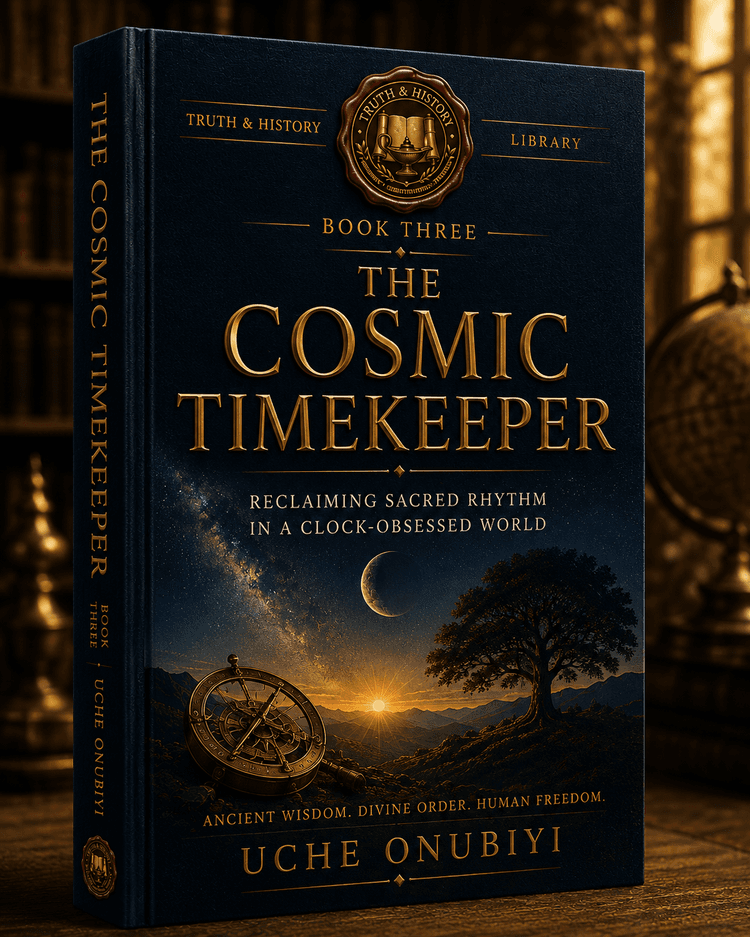
Continue the Journey
The Cosmic Timekeeper
This Journal explores one dimension of a much larger investigation into time, rhythm, natural cycles and humanity's relationship with the systems by which we measure our lives.
Read the Book →