
Rest can look like nothing is happening.
A person lies still. Work stops. Production slows. The screen goes dark. The office empties. The body closes its eyes.
If we judge life only by visible output, rest can appear to be empty time.
The living body tells a different story.
During sleep, human physiology does not simply switch off. Sleep is an actively regulated biological state associated with changing brain activity, hormonal regulation, memory processes, metabolic regulation, immune function and tissue maintenance.
Rest, more broadly, can reduce demands and create conditions for recovery after exertion.
What appears inactive from the outside may therefore contain processes essential to continued life.
A clock can count the hours in which nothing appears to be happening.
The living body may be using those hours to restore capacity.
01 · The Mistake of Calling Rest Nothing
Stillness and inactivity are not the same as biological emptiness.
Industrial and digital cultures have become extraordinarily good at measuring visible activity.
Hours worked. Messages answered. Products completed. Tasks closed. Meetings attended. Targets reached.
These measurements can be useful.
But what is easily counted can begin to define what we consider valuable.
Rest becomes vulnerable in such a system because its value is often indirect.
We see the person sleeping.
We do not see every process occurring within the sleeping person.
The absence of visible production is not proof that nothing valuable is taking place.
Diagram 01 · The Restoration Cycle
Sustainable activity contains recovery.
Activity → Expenditure → Rest →
Restoration → Renewed Capacity
02 · The Body Has Its Own Night Work
Sleep is not simply consciousness disappearing.
Human sleep has structure.
Across the night, the sleeping brain moves through recurring stages rather than remaining in one uniform condition.
Different sleep stages are associated with different patterns of brain activity and physiology.
Research connects adequate sleep with processes important to attention, learning, memory, emotional regulation, metabolic health, immune function and physical recovery.
This does not mean sleep is a magical repair mechanism capable of correcting every problem.
It means something more modest and more important: sleep is part of normal human biological regulation.
To repeatedly deprive the body of sleep is therefore not simply to remove leisure.
It is to interfere with a recurring physiological need.
03 · Circadian Time
The body does not experience every hour as biologically identical.
Human physiology contains circadian rhythms: approximately twenty-four-hour patterns coordinated by internal biological timing systems and influenced by environmental signals, especially the light-dark cycle.
Sleep and wakefulness are deeply connected to this temporal architecture.
Hormone secretion, body temperature, alertness and many other physiological processes vary across the day and night.
The implication is profound.
A clock may divide every day into twenty-four equal hours.
The body does not necessarily assign the same biological meaning to each of them.
Evidence
Sleep and circadian rhythms are established areas of human physiology. Sleep is actively regulated and associated with numerous restorative and regulatory processes.
Interpretation
We can interpret this biologically necessary alternation between activity and rest as evidence that continuous visible production is not the natural condition of a living human system.
Formation Insight
Rest can be understood as part of formation when it preserves, restores or prepares capacity for continued participation in life.
04 · When Productivity Becomes the Measure of Worth
A human being is not valuable only while producing.
There is a difference between valuing meaningful work and turning productivity into a measure of human worth.
The first recognizes contribution.
The second makes inactivity morally suspicious.
Under that logic, exhaustion can become a badge of seriousness. Busyness becomes evidence of importance. Rest begins to require justification.
Women can experience this pressure intensely because paid work may exist alongside forms of care, emotional labour, household responsibility and community obligation that are not always counted as work.
The result can be a strange contradiction:
the person responsible for sustaining others may feel guilty for sustaining herself.
Diagram 02 · Two Ways of Reading Time
Clock Logic
More hours
= more output
Living-System Logic
Exertion + recovery
= sustainable capacity
This comparison is a conceptual model, not a physiological equation. Its purpose is to distinguish continuous-output thinking from the activity-recovery patterns found throughout living systems.
05 · Rest Is Not Always Sleep
Restoration has more than one doorway.
Sleep is biologically indispensable, but rest is a wider category.
A person can be awake and still reduce demand.
Quiet. Solitude. Reduced stimulation. A break from concentrated mental work. Sitting without performing. Walking without trying to achieve a target. Temporarily relinquishing responsibility to another capable person.
These experiences are not physiologically identical and should not be treated as substitutes for adequate sleep.
What they share is a temporary change in demand.
Rest therefore asks a more useful question than simply, "Am I doing nothing?"
It asks, "What demand has been reduced, and what capacity does that reduction allow to recover?"
06 · The Feminine Capacity to Withdraw
Life does not remain permanently open.
Within the Feminine Renaissance, the feminine is not another word for woman.
It names life-giving capacities present within human formation: receiving, nurturing, protecting, relating, carrying, regenerating and bringing life toward maturity.
Rest belongs naturally beside these capacities because regeneration requires intervals in which outward demand is reduced.
A boundary closes.
Attention turns inward.
What has been expended is given an opportunity to recover.
Withdrawal, in this sense, is not rejection of life.
It can be one of the ways life protects its ability to return.
Rest is not the opposite of life.
Sometimes rest is life protecting its capacity to continue.
07 · Rest Has a Boundary Too
Restoration should eventually return us to participation.
To recover the intelligence of rest does not mean glorifying permanent withdrawal.
Rest has purpose because life continues.
There are times when inactivity may reflect illness, depression, injury, exhaustion or other conditions requiring care rather than a philosophical celebration of stillness.
There are also moments when what we call rest may actually be avoidance.
Wisdom therefore asks not only whether we have stopped.
It asks what the stopping is doing.
Is it restoring capacity?
Is it protecting something that needs recovery?
Or has the season for returning already arrived?
Formation Insight
The seed beneath the soil is not wasting time.
Not every important process announces itself through visible activity.
Some capacities are restored in quiet.
Some understanding settles only after we stop forcing another answer.
Some forms of creativity require periods in which nothing appears ready to be shown.
Rest reminds us that formation includes intervals that cannot be judged solely by what they immediately produce.
Carry This With You
What if exhaustion is not always proof that you have done enough?
Where have you learned to associate busyness with worth?
What kind of demand most often exhausts you: physical, cognitive, emotional, relational or sensory?
What form of rest actually restores that capacity?
Do you wait until exhaustion forces you to stop?
What responsibilities could sometimes be shared rather than continuously carried alone?
And what might become possible if restoration became part of your rhythm rather than an emergency response to collapse?
Activity has its hour.
Rest has its intelligence.
Restoration has its work.
And life knows when it must return.
Continue the Collection
Why Every Season Cannot Be
a Season of Production
Living systems move through different seasons of emergence, growth, fruitfulness, evaluation, release, stillness and renewal.
Next Journal →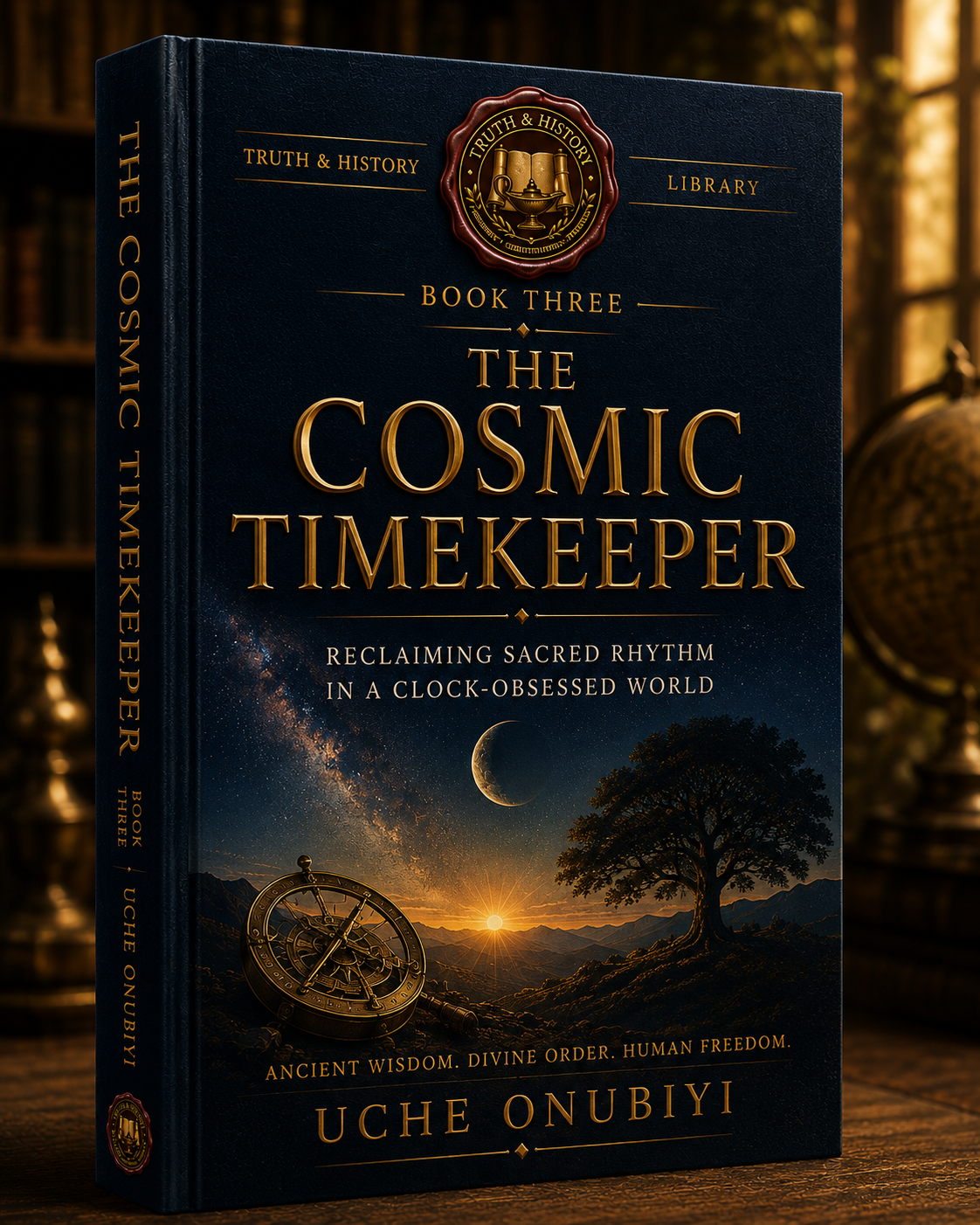
Read More
The Cosmic Timekeeper
Continue the exploration of circadian rhythm, natural time, cycles, seasons and what changes when human life is measured only by the clock.
Read the Book →