
We often speak about the body as though somewhere inside it there were a clock.
The phrase biological clock is useful because it points toward something real: living organisms contain internal timing systems.
But the metaphor can also become too small.
A clock tells us what time it is.
A living body does much more.
It sleeps and wakes. It releases hormones according to temporal patterns. It changes temperature. It repairs. It becomes hungry. It prepares. It menstruates. It ovulates where ovulation occurs. It grows. It matures. It ages.
These processes do not all operate on one timescale.
Some unfold across hours. Some across days. Some across approximately a month. Others across years or entire stages of life.
The body is therefore not simply keeping time. It is living through many forms of time at once.
What changes when we stop imagining the body as a clock
and begin reading it as a living calendar?
01 · The Clock Was Never the Whole Story
Mechanical time repeats units. Living time changes states.
One minute is designed to be equivalent to the next minute on a clock.
That uniformity is precisely what makes mechanical time so useful.
It allows meetings to begin together, transport systems to be coordinated, experiments to be measured and societies to organize shared activity.
But biological time is not experienced as a succession of identical units.
Midnight and midday are both sixty-minute hours, yet the body does not necessarily treat them as equivalent physiological conditions.
The same is true across longer cycles.
A living system may move through preparation, activation, expression, recovery and renewal while the clock continues counting identical seconds.
Diagram 01 · One Body, Multiple Rhythms
Biological time is layered.
Daily
Circadian Rhythm
Sleep, wakefulness, alertness, hormone timing, temperature and metabolism participate in roughly 24-hour patterns.
Monthly
Reproductive Rhythm
For menstruating women, reproductive physiology unfolds across a cycle rather than remaining biologically identical from day to day.
Seasonal
Environmental Rhythm
Light exposure, temperature, activity and social patterns can change with seasons and environments.
Life
Developmental Rhythm
Puberty, reproductive maturity, pregnancy where it occurs, perimenopause, menopause and ageing mark longer transitions through embodied time.
These categories are not separate machines. They interact within one organism while operating across different timescales.
02 · The Body Reads the Environment
Internal time is not completely isolated from external time.
Biological timing systems receive information from the environment.
Light is one of the most important examples.
The daily light-dark cycle helps synchronize human circadian timing with the approximately twenty-four-hour day.
Meals, activity, social schedules and other recurring signals can also participate in the timing of physiological processes.
This means that living time involves relationship.
The organism has internal rhythms, but it also exists within an environment containing recurring signals.
A living calendar is therefore neither purely internal nor purely external. It emerges through interaction.
03 · The Female Body Makes Changing Time Visible
Menstruation makes recurrence difficult to ignore.
For a menstruating woman, the reproductive cycle provides a particularly visible example of embodied recurrence.
Bleeding returns, but the body has not simply been waiting in an unchanged condition for the next period to arrive.
Hormonal and reproductive processes have been changing across the cycle.
This does not mean every woman experiences the same symptoms, emotions, energy levels or capacities at the same point in her cycle.
Nor should the menstrual cycle become a rigid timetable used to tell women what they must feel or what they should be able to do.
Its deeper lesson for this Journal is simpler.
Recurrence does not require sameness.
Something can return while the living system passes through different conditions on the way back.
A clock tells you that time has passed.
A calendar tells you where you are within a larger pattern.
04 · From Rhythm to Season
A living calendar recognizes changing conditions.
We normally use the word season for changes in the natural year.
But season is also a useful interpretive language for living processes.
A season is not simply a quantity of time.
It is a condition within time.
Germination is different from fruiting. Fruiting is different from release. Release is different from dormancy.
None is meaningless because it does not look like the other.
This is where the metaphor of the living calendar becomes powerful.
It asks us to notice not merely how much time has passed, but what kind of work a particular period appears to be carrying.
Diagram 02 · The Living Calendar
Signal
The body receives information from within and from its environment.
Response
Physiology changes rather than remaining in one permanent state.
Pattern
Repeated changes begin to reveal recognizable rhythms.
Season
Different phases carry different conditions, capacities and demands.
Memory
Observation across time allows the person to recognize what tends to return.
Participation
Knowledge of rhythm can inform how we work with time rather than pretending every moment is identical.
Signal → Response → Pattern →
Season → Memory → Participation
05 · Calendar Requires Memory
You cannot recognize recurrence without remembering return.
A single event tells us very little about rhythm.
Rhythm becomes visible through recurrence.
That is why calendars are forms of memory.
They preserve relationships between what happened, when it happened and when something similar returned.
The same principle applies to embodied observation.
A woman who records her menstrual cycle, sleep, energy, symptoms or other recurring experiences begins building a personal archive.
The purpose is not to become obsessed with measurement.
It is to make recurrence visible enough to distinguish an isolated event from a pattern.
Diagram 03 · Clock Time and Living Calendar
Clock Logic
How much time?
Measures standardized units.
Coordinates shared schedules.
Treats an hour as an hour.
Excellent for synchronization between people.
Necessary for modern social organization.
Living Calendar
What time is this?
Observes changing biological states.
Recognizes recurrence.
Notices transitions and seasons.
Compares the present with remembered patterns.
Allows timing to carry qualitative meaning.
The living calendar does not replace the clock. It restores information the clock was never designed to provide.
06 · Modern Life Can Hide Biological Time
The schedule can remain constant while the organism changes.
Modern societies depend heavily on standardized time.
Work begins at a particular hour. Deadlines arrive on a particular date. Schools, markets, hospitals, airports and digital systems require coordination.
The problem is not the clock itself.
The problem begins when clock time becomes the only kind of time we know how to recognize.
A person may be exhausted while the schedule says continue.
A body may need recovery while the calendar says produce.
A developmental transition may be underway while society expects yesterday's identity to continue unchanged.
Mechanical time can tell us when the meeting begins.
It cannot tell us what season a human being is passing through.
07 · Reading the Body Without Worshipping It
Attention is different from obedience to every sensation.
Recovering bodily awareness does not mean treating every feeling as an unquestionable command.
Bodies can be tired because rest is needed.
They can also be tired because of illness, stress, inadequate nutrition, medication, disrupted sleep or many other conditions.
A changing menstrual pattern may be part of an ordinary transition, but persistent or concerning changes can also warrant medical attention.
The purpose of becoming attentive is therefore not self-diagnosis.
It is increased literacy.
Learn what is ordinary for you. Notice meaningful change. And seek appropriate expertise when the change requires more than observation.
08 · From Control to Participation
The deepest shift may be in how we relate to time.
Clock culture easily turns time into something we must defeat.
Save time.
Beat time.
Race against time.
Never waste time.
A living-calendar perspective asks a different set of questions.
What is happening now?
What has been returning?
What is changing?
What is ripening?
What needs recovery?
What has completed its season?
What is beginning?
This does not abolish discipline. It gives discipline context.
Formation Insight
A clock asks,
“What time is it?”
A living calendar asks,
“What is this the time for?”
One measures position within standardized time. The other asks us to recognize position within a process.
Human beings need both.
The problem begins when we become fluent in the first and illiterate in the second.
Living Calendar Practice
Build a small archive of your own rhythm.
For several weeks or months, record only a few variables rather than trying to measure everything.
Do not begin by trying to prove a theory. Begin by observing. After enough time has passed, ask what actually repeats, what varies and what conditions seem to accompany the changes.
Carry This With You
Do you know what season you are in?
Which rhythms in your life are already obvious to you?
Which ones have you never observed long enough to recognize?
Where are you demanding consistency from a body or life that is actually passing through transition?
What is returning?
What has stopped returning?
What might your present season be preparing rather than producing?
Your body is not merely moving through hours.
It is moving through states.
Through transitions.
Through recurrence.
Through seasons.
Perhaps learning to live in time begins when we stop asking only how much time has passed and begin noticing what kind of time we are living through.
Evidence & Interpretation
Biological Evidence
Circadian timing, hormonal rhythms, sleep-wake regulation and reproductive cycling are biological phenomena. Living organisms contain multiple timing processes operating over different timescales.
Formation Interpretation
Calling the body a “living calendar” is the interpretive framework of this Journal. It describes a way of reading recurrence, changing states, seasons and developmental time; it is not a separate anatomical structure inside the body.
Continue the Collection
The Elder Woman
as Keeper of Time
What does a woman carry when she has lived long enough to remember what another generation is encountering for the first time?
Next Journal →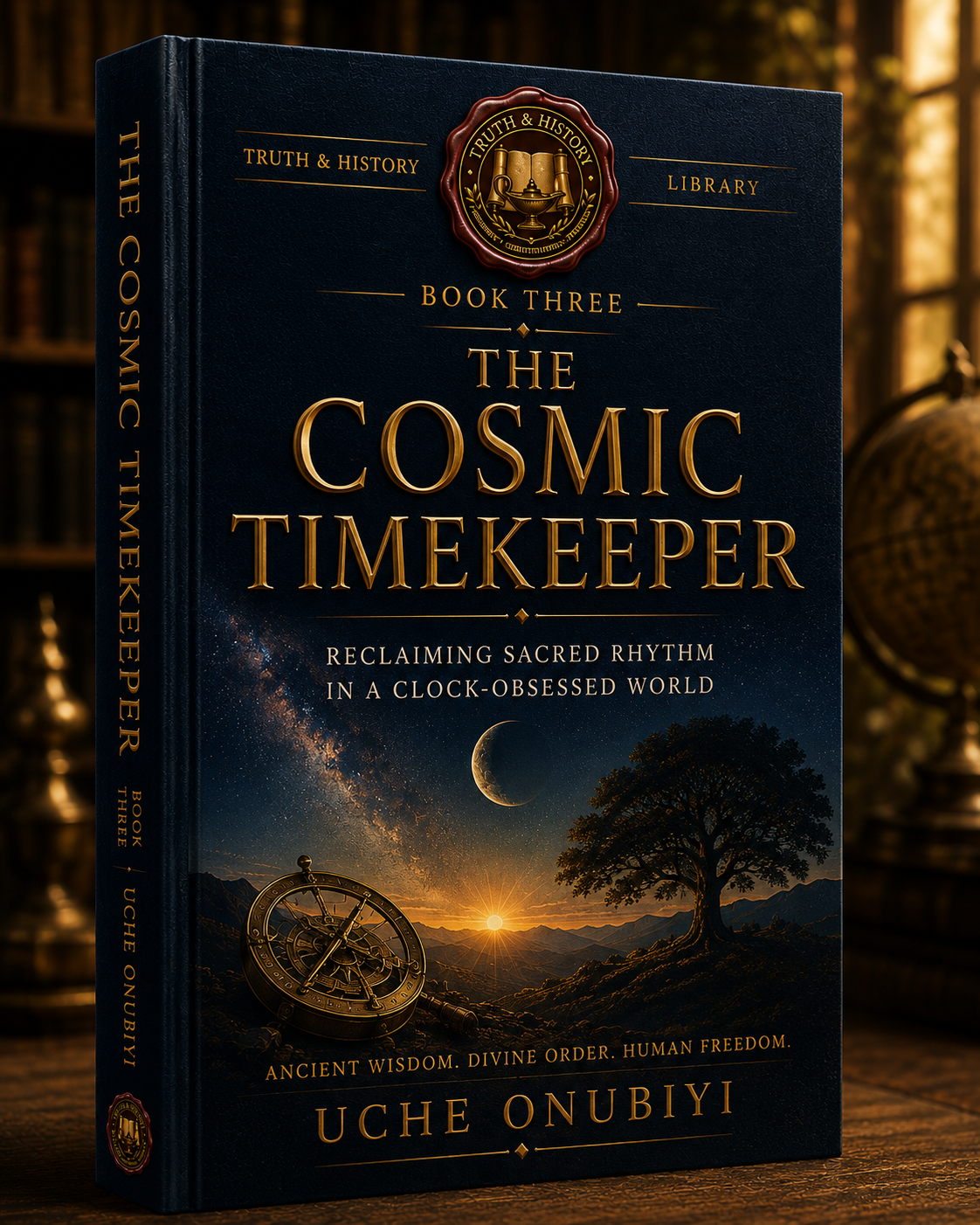
Read More
The Cosmic Timekeeper
Explore the wider relationship between biological rhythm, natural cycles, circadian time, seasonal movement and the difference between mechanical time and living time.
Read the Book →